Does One Person Matter?

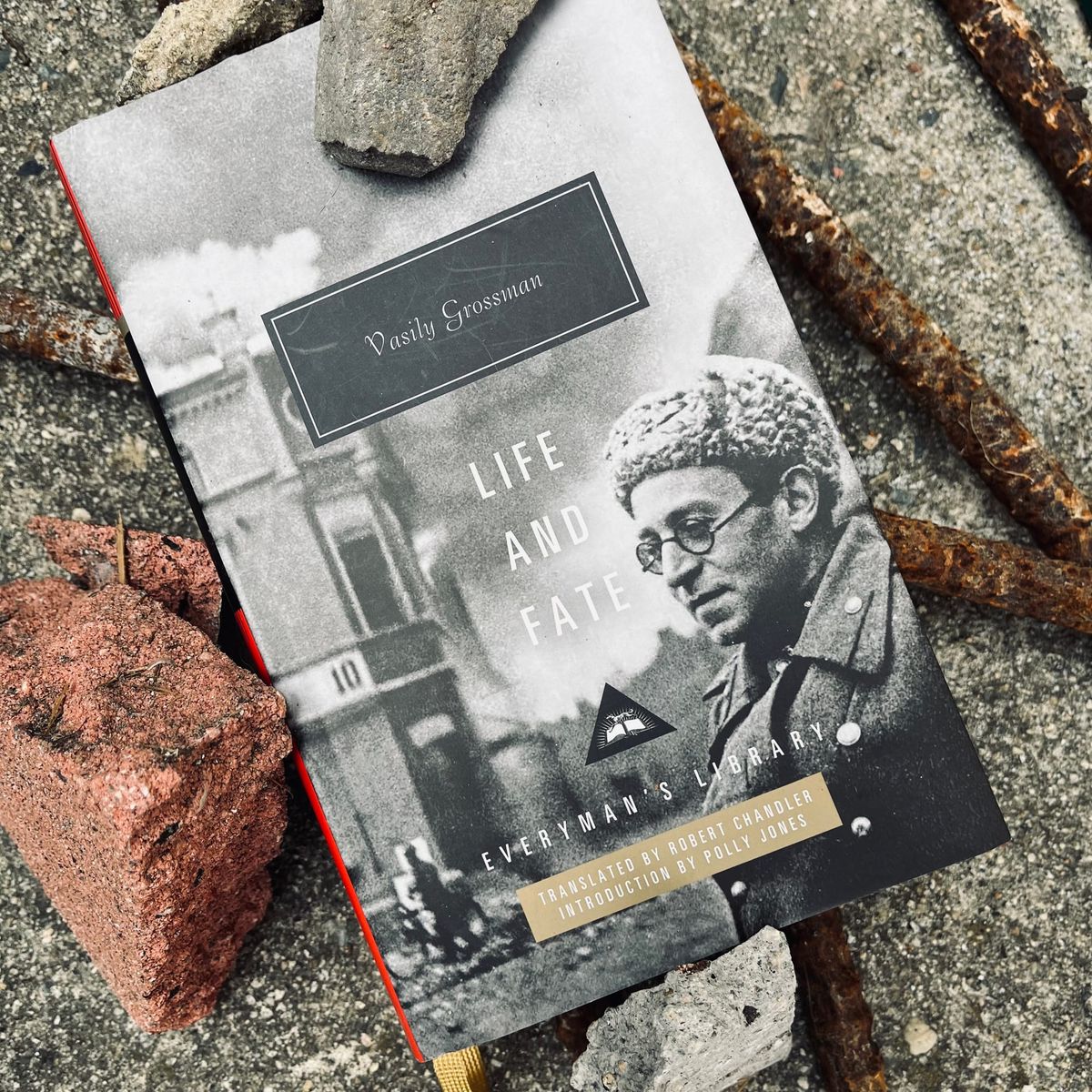
An estimated two million people were killed, wounded, or went missing in brutal urban fighting in the Battle of Stalingrad between July 17, 1942 and February 2, 1943. A Russian correspondent, Vasily Grossman was an eye-witness to the battles of Moscow, Stalingrad, and Berlin. The Battle of Stalingrad is Grossman’s narrative context for his novel, Life and Fate. But Life and Fate is no military chronicle. Rather, it is the story of individuals caught in the grip of titanic forces, trying to live when death is a daily occurance, grappling with the cruelty and compassion of their fellow humans. It seeks to understand how the human spirit is kept alive when political regimes demand loyalty at any cost.
There is Victor Shtrum, Jewish physicist trying to serve the Russian war effort while his own mother is behind German lines in Ukraine. Victor’s wife, Lydmilla, who desperately grieves for her son Tolya, a casualty while serving in the Russian army, their daughter Nadya, who lacks either fear or reverence for the Communist Party. And on it goes. There are military commanders and political officers, friends and foes, lovers and deceivers, both German and Russian. All are caught in the deadly maelstrom created by two competing ideologies: Nazism and Communism.
I discovered Life and Fate in the B.C. era (Before COVID) when I was commuting to work. I was in a music/podcast rut. I had friends who were audiobook fans and decided to try Audible’s 30-day trial subscription. I encountered a BBC dramatization of Life and Fate featuring Kenneth Branaugh and David Tennant. I had never heard of Vasily Grossman or his book, but I read the summary and decided to give it a try. For literary purists, a dramatization is not ‘the book’, but an adaptation. I get that. I just needed something to relieve the monotony of my drive to San Diego.
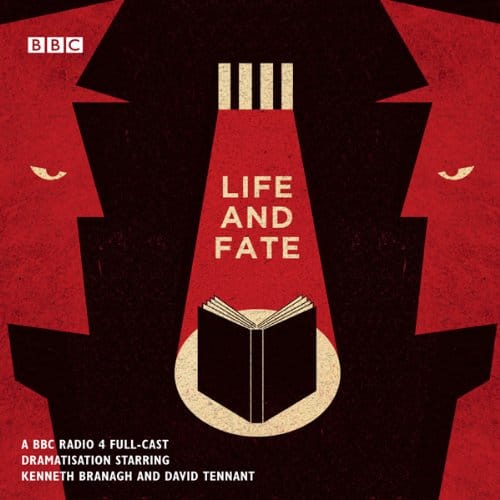
I had no idea what I was getting into. The BBC dramatization was brilliant, it was sobering, it was tragic, it was deeply, deeply human. I listened to it at least three times. I went to Barnes & Noble and found the only edition of Life and Fate available at the time, the New York Review Books paperback edition. I read it, all 900 pages, in early 2020, red pen actively marking poignant, insightful prose. It was as compelling as the audio drama.
Then, in 2023, I was wandering through B&N and saw the Everyman’s Library edition – those beautiful red cloth hardbacks with the gold marker ribbon. Did I need it? No. Did I have to have it? Yes. 2026 has been a year for rereading. So, I picked up this pristine edition of Life and Fate (red pen in hand, again). Did I still find it as rewarding? YES!
Grossman takes the reader into the home of Victor Shtrum, inside the tank of a division commander, on the desperate skirmishes of a small squad of Russian soldiers defending a crumbling brick building in the middle of Stalingrad, in the parallel worlds of the German concentration camps and the Russian Gulag where humanity is put to its severest test by loyal minions of each state system, in quiet offices of the Lubyanka where the meaning of truth and loyalty are twisted beyond recognition. And yet, there is love and friendship and tenderness in the midst of it all.

Grossman quotations from Life and Fate
ON STATE POWER
· If you attempt to erase the peculiarities and individuality of life by violence, then life itself must suffocate.
· What a wonderful power and clarity there is in speaking one’s mind. What a terrible price people paid for a few bold words.
· Only people who have never felt such a force themselves can be surprised that others submit to it. Those who have felt it, on the other hand, feel astonished that a man can rebel against it even for a moment – with one sudden word of anger, one timid gesture of protest.
· True believers always want to bring God to man by force…
· What’s really terrifying is when you realize that bureaucracy isn’t simply a growth on the body of the State. If it were only that, it could be cut off. No, bureaucracy is the very essence of the State.
· Everyone feels guilty before a mother who has lost her son in a war; throughout human history men have tried in vain to justify themselves.
· There is one right even more important than the right to send men to their death without thinking: the right to think twice before you send men to their death.
ON RELATIONSHIPS
· His whole life had been reflected in that of his wife; everything good or bad that had happened to him, all his feeling of joy and sadness, had importance only in so far as he was able to see them reflected in her soul.
· Everything that lies half-buried in almost every family, stirring up now and then only to be smoothed over by love and trust, had now come to the surface…
· What lay between them was true and natural, they were no more responsible for it than a man is responsible for the light of day – and yet this truth inevitably engendered insincerity, deceit, and cruelty towards those dearest to them.
ON WHAT IS GOOD
· The only true and lasting meaning of the struggle for life lies in the individual, in his modest peculiarities and in his right to those peculiarities.
· This kindness, this stupid kindness, is what is most truly human in a human being. It is what sets man apart, the highest achievement of his soul.
· … the purest souls are constantly and inevitably the prey to doubt. The world is always dominated by limited men, men with an unshakeable conviction of their own rightness. The purest souls never take great decisions or hold sway over States.
· Good men and bad men alike are capable of weakness. The difference is simply that a bad man will be proud all his life of one good deed – while an honest man is hardly aware of his good acts, but remembers a single sin for years on end.
There are entire chapters I wanted to excerpt, especially Chapter 18 (Part 1), which is a letter written by Victor’s mother from a Jewish ghetto in Ukraine.
For an accurate, readable, non-fiction narrative of the Battle of Stalingrad, I recommend Enemy At The Gates by William Craig.
A small math lesson: By reading five pages a day, just five, you can finish Life and Fate in six months. See, that’s not so bad, is it?
Does the individual matter? Grossman says yes. In our flawed and equivocating passage through this world, alternating between bold idealism and craven self-preservation, between pettiness and nobility, what you and I do matters. By resisting crushing conformity to the tribe or the party, but instead responding to the spark of humanity that flickers in that person right in front of me, I recognize the value of one unique soul.
Until next time...