The Truth Be Told
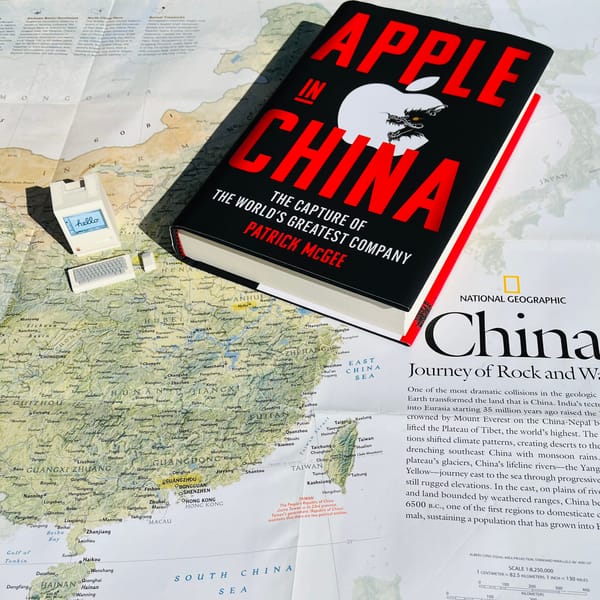
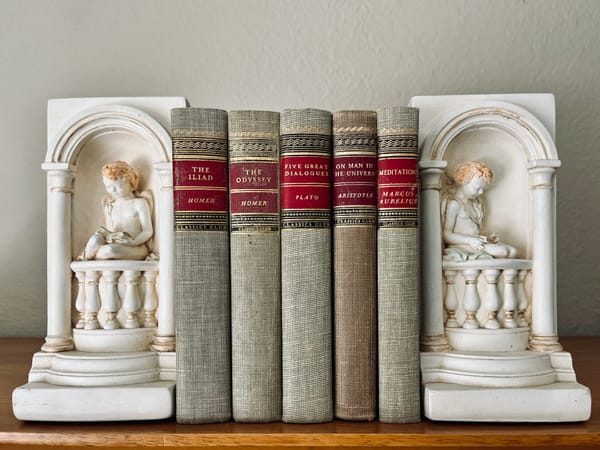
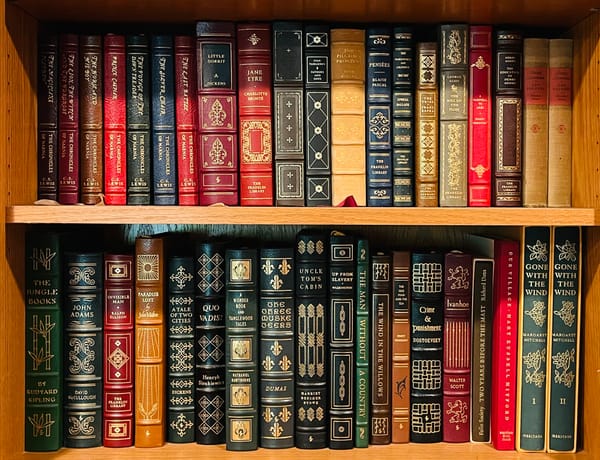
Christians are people of a book – The Bible. As many of my Book Bound readers know (see About and Archive pages on Book Bound), I was raised in a Pentecostal Christian denomination. I said a prayer accepting Jesus at a very young age. I have read the entire Bible through at least a dozen times, some sections many times more. The idea was that the more I studied, the more I would understand God and what He expected. But, a funny thing happened. The more familiar I became with the Bible, the less it fit into a tidy theological package. In fact, when I let myself admit it, whole swaths of the Bible were weird, especially when forced to fit a modern context. Along this multi-decade journey, I read many books on religion (see photo for a few), as I tried to reconcile my faith with my lived experience.
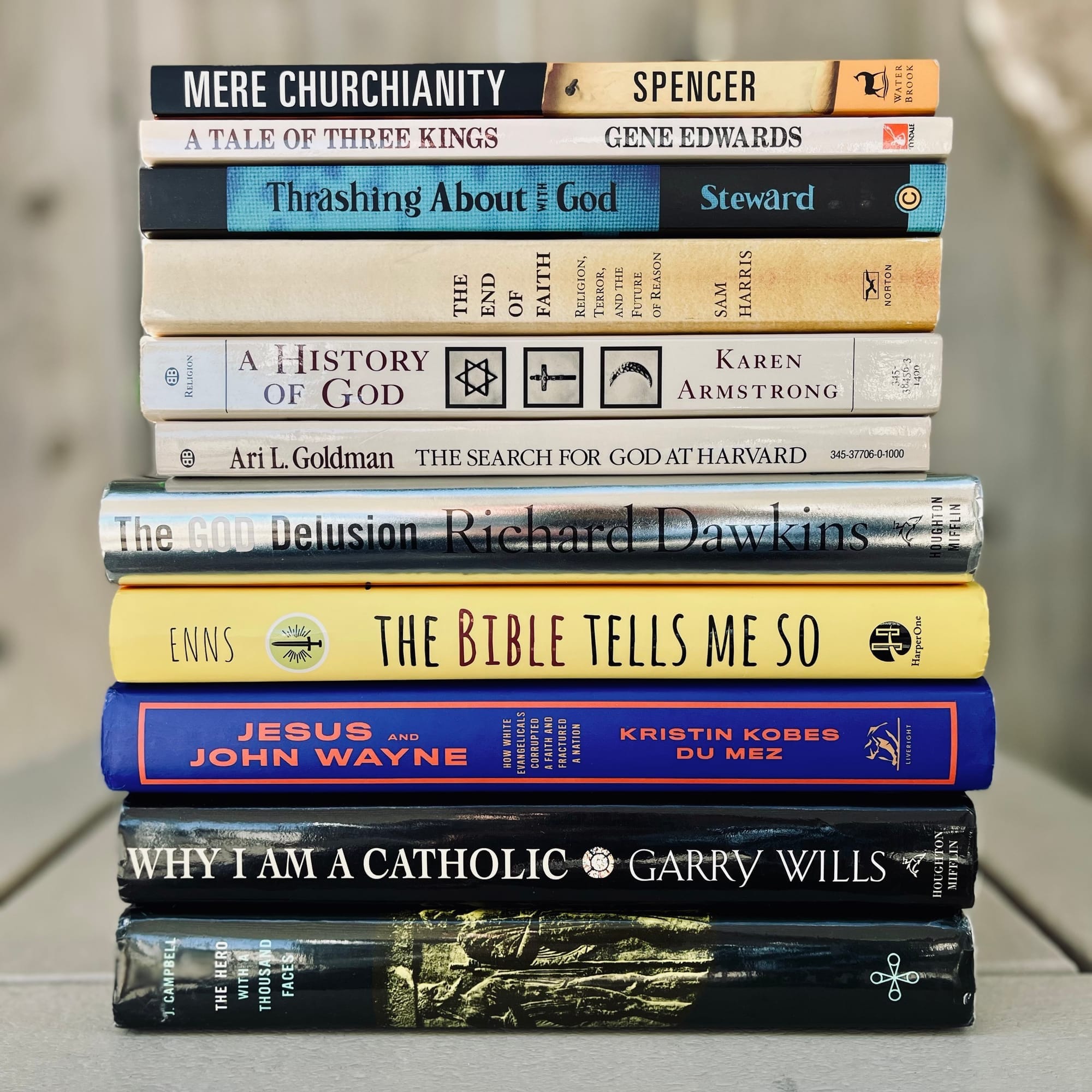
I recently finished another book in that vein. It made me think. Hard. So, while I aim to cover two books in a typical post, I need to give this single book my full attention.
What, exactly, do you believe?
We Of Little Faith by Kate Cohen caught my eye in Barnes & Noble last December. The title recalls a story I heard as a child in Sunday School. Jesus and his disciples are in a boat on the Sea of Galilee. Then this happens:
And, behold, there arose a great tempest in the sea, insomuch that the ship was covered with the waves: but he was asleep. And his disciples came to him, and awoke him, saying, Lord, save us: we perish. And he saith unto them, Why are ye fearful, O ye of little faith? Then he arose, and rebuked the winds and the sea; and there was a great calm. (Matthew chapter 8, verses 24-26, King James Version).
I picked up the book and read the jacket notes, which convinced me to go further:
“… Kate Cohen does not dismiss religion as dangerous or silly. Instead, she investigates religion’s appeal…”
Because if you look carefully, you can see The God Delusion by Richard Dawkins in the stack of books pictured at the top of the post. Dawkins is a condescending atheist who considers religion dangerous and silly (although less so recently, I hear). The God Delusion was not enjoyable to read. I was not eager for another book telling me how stupid I was for maintaining any vestige of religion. However, I wanted to hear what Cohen, raised with a Reformed Jewish heritage, had to say about faith. I bought the book and started reading right after Christmas.
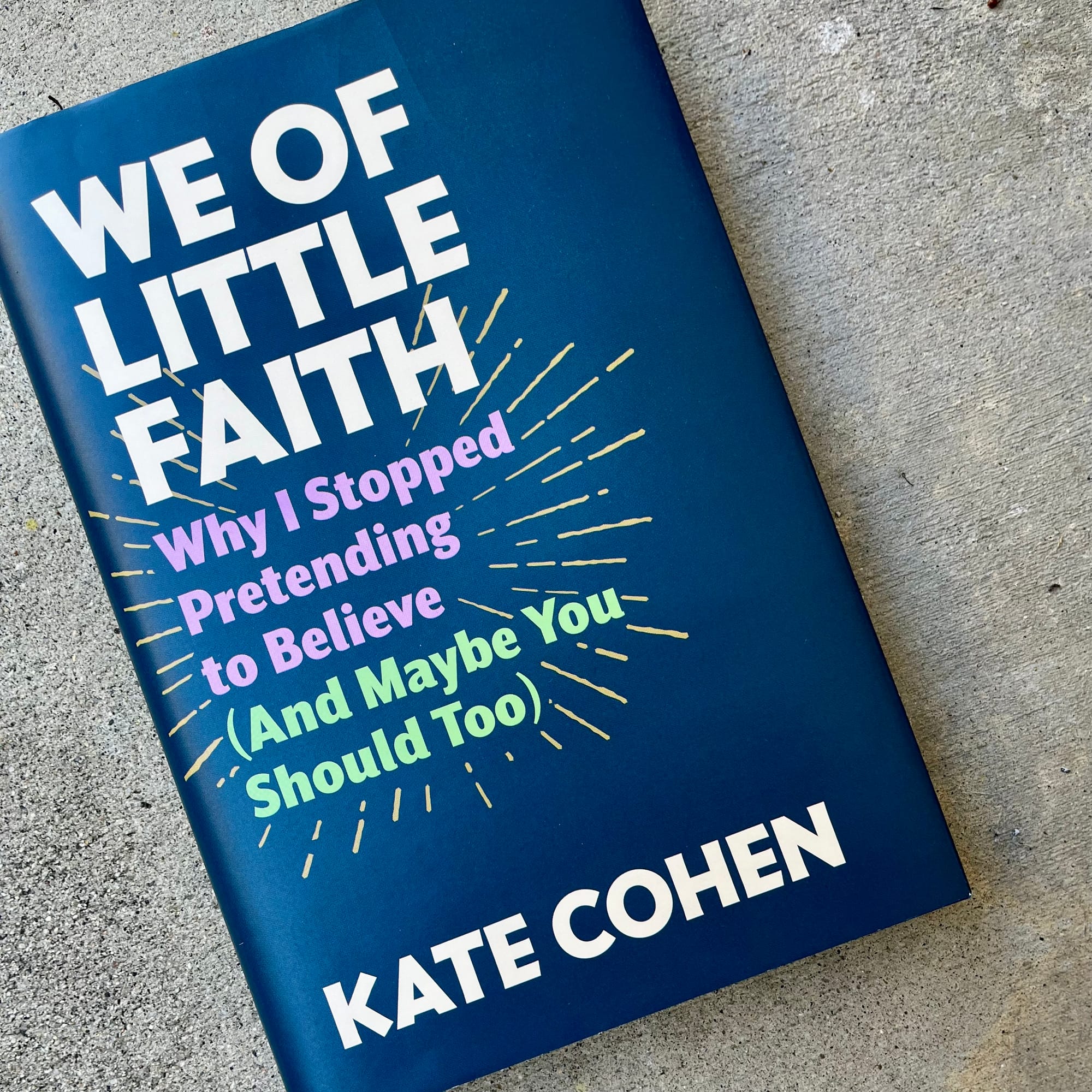
Kate Cohen is a splendid writer, with a fine sense for balancing the serious with appropriate humor. Reading We Of Little Faith was a pleasure from that standpoint alone.
In Part One: The Making of an Atheist, Cohen takes us from her small-town childhood to becoming a parent herself. When she became a parent, she committed to being truthful with her children about everything, especially her view of God, knowing this would create tension with family members. She defines and contrasts terms like myth, religion, atheist, agnostic. She investigates what we can truly know about God and our sacred writings.
In Part Two: What We Lose and What We Gain, Cohen explores the role religion fills in addressing life’s biggest questions and needs. A few chapter highlights:
· Life with No After – Here she grapples with the inevitable loss that death brings to us and to those we love, and how to live with that knowledge.
· How to Start Your Own Holiday - Cohen acknowledges that without gods, ‘holy’ days lose meaning. Inventing your own holiday is a long shot. But, she is a fan of both the gratitude and food of Thanksgiving Day! (Me, too.)
· How Will We Know Right from Wrong? - So enjoyed this. Cohen made me consider whether I derive my morals from scripture, or I impose my morals on them. Cohen confronts the problem of God doing or allowing what we humans would call evil in the Bible and other sacred texts.
· Take Me to Church - Her story mirrored my own sense of loss that has come when leaving a religious community and the difficulty in finding a replacement.
· Are You There, Not Me? It’s Me – All about prayer: the use of older language to lend mystery, the mental wandering with ‘silent prayer’, the challenge of knowing what prayer accomplishes. Excellent, honest, hard-hitting.
Reading We Of Little Faith was an insightful exploration of life’s deep questions. Kate Cohen and I agree on many things, but especially about the necessity of truthfulness in matters of faith. Like her, I wrestle with how to be truthful about the limits of my religious convictions without alienating a lot of people. But I am going to try. Starting now.
Honest to God... and you
First, while I find the Bible a fascinating book that contains much wisdom, I do not consider it the “infallible and inerrant word of God”. I believe it was written by human beings based on their experiences with the divine as they understood it in their time. The Bible is at times beautiful, confusing, disturbing. It may at times speak for God. But it is not God.
Second, while I have given prayer my best shot for a long time, I have never found a correlation between my prayers and subsequent events. Certainly, no miracles. The cliché “sometimes God says ‘yes’, sometimes God says ‘no’, sometimes God says ‘wait’“ seems to be a convenient way to explain the randomness with which, for example, some people recover after being prayed for and some people die. Prayer mostly feels to me like talking to the ceiling.
Third, my experience has been that Christians, who are supposed to be noticeably better in their behavior, have not proven to be any more kind, loyal, or honest than the Buddhists or agnostics or Muslims or Hindus I have known and worked with or had as neighbors. It is accurate to say that both my best and worst relationship experiences came with people who were Christians (or claimed to be).
Most of what remains of my historical Christian faith is found in the great love commands of the Bible, in which I see vital truth: love your neighbor as yourself, love your wife as Christ loved the church, love your enemies, love one another. If I ever get those right, I might start worrying about some of the other details of faith.
There is much more that I could (and no doubt should) say, but this is plenty for now. It is my attempt at honesty as a person of ‘little faith’, and I hope it will be understood that way.
Oh, and I do hope you read We Of Little Faith. It will be well worth your time.
Until next time…