Sex & Literature

Now that I have your attention, let me define my terms. By sex, I mean the array of activities that preceed, include, and follow intercourse. By literature, I mean books that are considered to have a high aesthetic value. Of course, in this era where value is thought to be primarily, if not exclusively, an individual determination, I will be swimming upstream. There is no longer any accounting for taste, or lack thereof.
In my search for worthwhile books, I keep running into contemporary works of ‘literature’ – acclaimed, prize-winning, best sellers – that rely on blow-by-blow, anatomically elaborate descriptions of sex. Lest you think I have something against sex itself, it is precisely because I find sex fascinating and wonderful that I prefer less of it in literature. Because, frankly, the descriptions fall drastically short.
I read a lot of Alistair MacLean books in my high school years, a time when my interest in sex was virtually unlimited. He wrote thrillers, not precisely ‘great literature’. But, he sold millions of copies without descriptions of sex. Perhaps my favorite living author is Marilynne Robinson, 2005 Pulitzer Prize-winner. Her works are recognizably ‘great literature’, successful commercially and artistically without sex. These are just two examples of story-telling done well without sex. Why then, do authors feel extensive sex scenes are necessary? What does it add to the narrative?
In my admittedly narrow experience, when (usually male) authors plop these erotic moments into their narrative, the female counterpart seems mostly an accessory for the man’s pleasure. And what man doesn’t want that? I can’t say how a woman would feel reading those passages, but it says something about how the author views women and himself. I find it distracting, like a couple excusing themselves in the middle of a dinner party with a group of friends because they just couldn’t wait for sex. Which has never happened to me in real life, I might add. And I am not making a suggestion…
An author has limited time and space to create a story and characters. I have a limited attention span. I need to know what is compelling about the story and its characters. I don’t need a bedroom scene thrown in to make up for weakness elsewhere.
That screed is my introduction to an actual book where sex is a major plot point. Let’s face it, without sex, a lot of dynamism goes out of the human story and it would end rather abruptly in one generation. So, kinda necessary.
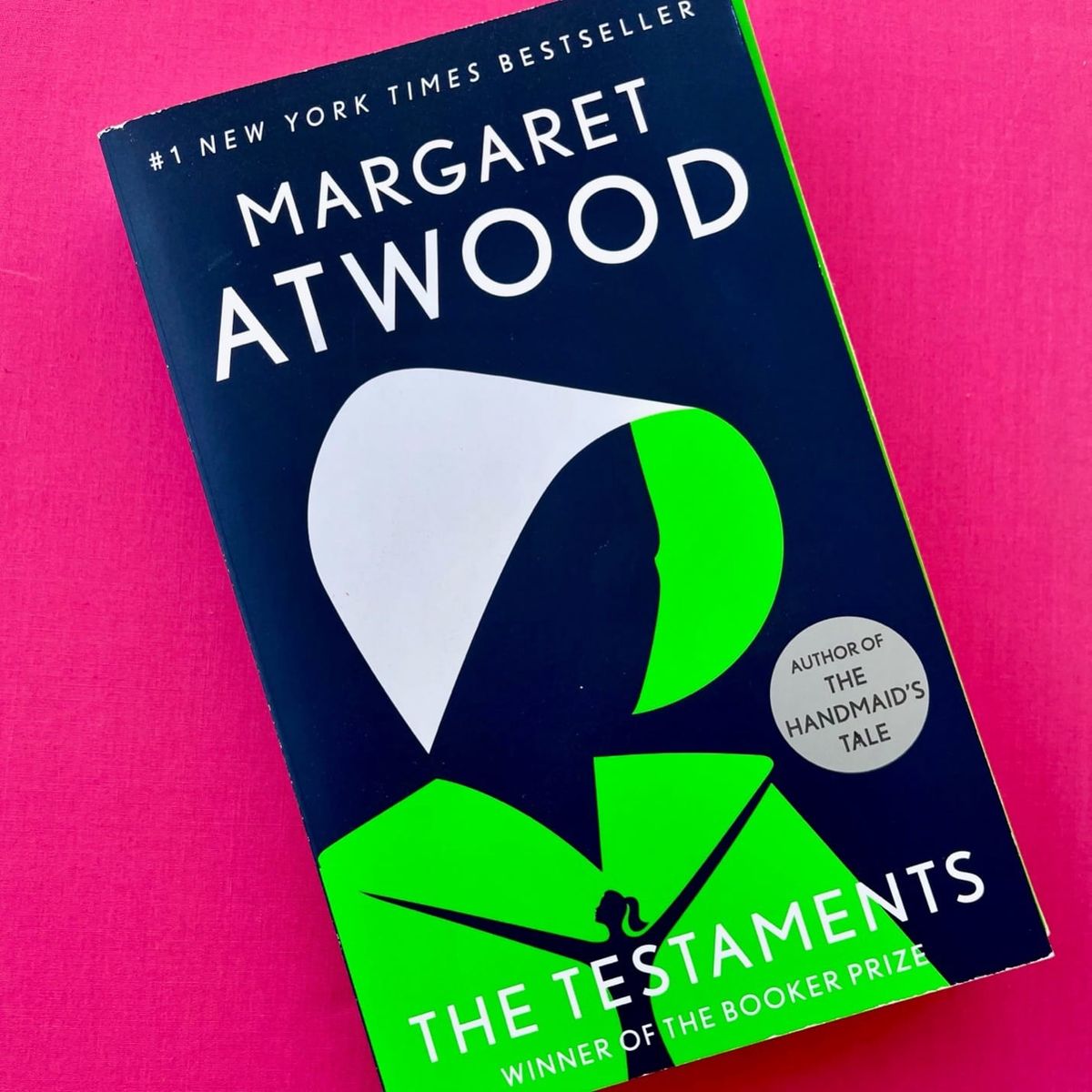
The Testaments is Margaret Atwood’s sequel to The Handmaid’s Tale, covered in Book Bound #5 in the Books, Mostly archives. Told by three female characters, The Testaments picks up fifteen years after the ambiguous ending of The Handmaid’s Tale. Gilead, a portion of what was the United States, is still grappling with declining fertility in its authoritarian society.
The lurking question that Atwood raises but does not fully answer is whether men and their ravenous sexual appetites are a product of the Gilead society, or is it the Gilead society that is the logical outcome of a society ruled by men? And just what is it that makes Canada a better place, eh?
I appreciate Atwood’s understanding of Christian culture. She references scripture and revered historical figures of the church. I learned a great deal about Job’s daughters! To some, her writing may seem to denigrate faith. My take is that The Testaments is intended to show how truth can be nudged and warped to produce massive error.
Despite the centrality of reproduction and male-female relations to the story, there is little ‘carnal’ activity in The Testaments. Certainly less than in The Handmaid’s Tale, and it is never gratuitous. As a work of literature, The Testaments is a fitting sequel. Though like most sequels, it is not quite as compelling as its predecessor. Certainly a book that will make you think about the relationship between the sexes.
"I like girls, I just don't write them well. Everyone knows that men and women make love, laddie – there is no need to show it." – Alistair MacLean
And Adam knew Eve his wife; and she conceived… Genesis 4:1
No further explanation necessary. Until next time…